

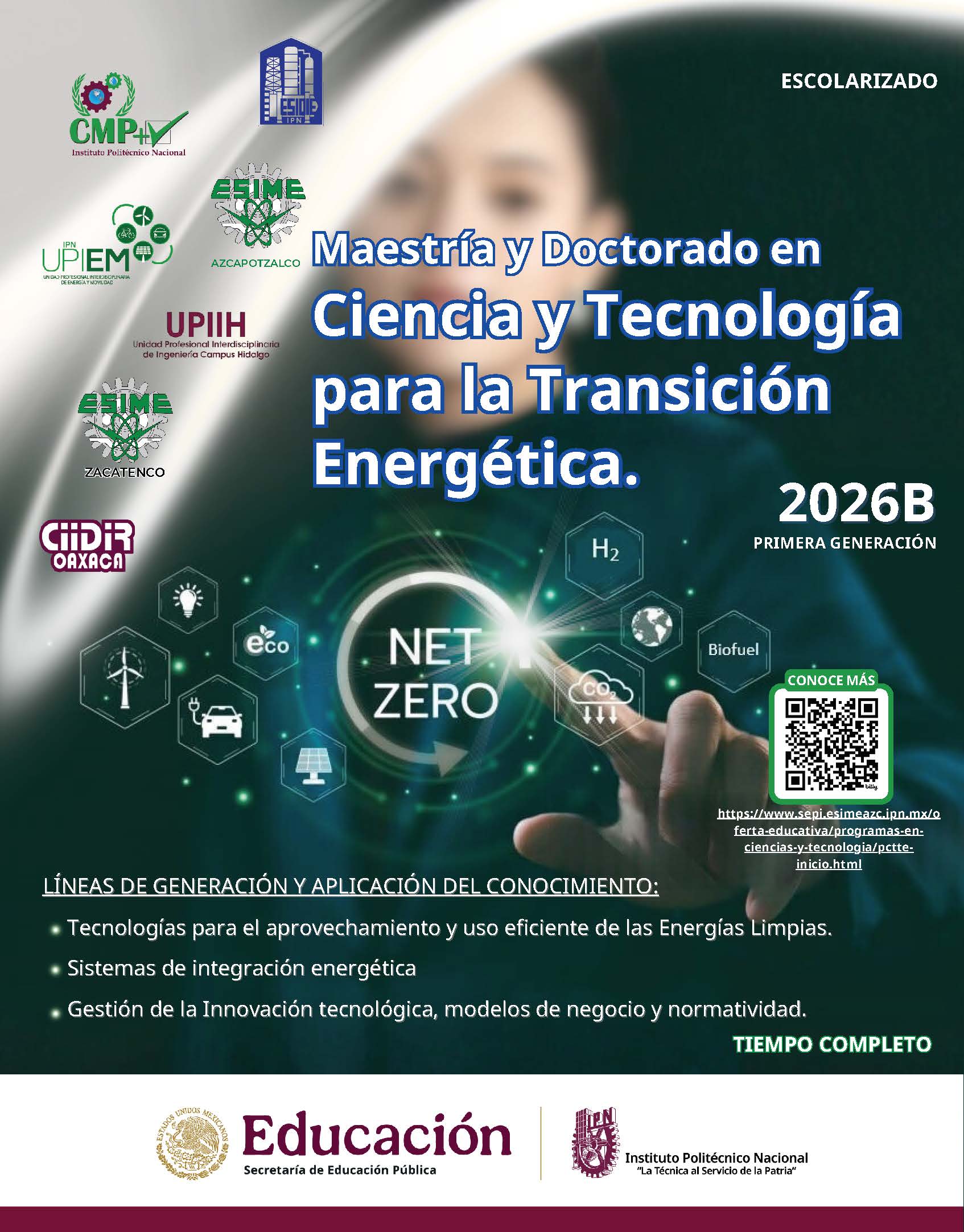
Formar investigadores líderes con capacidad para generar conocimiento científico original, desarrollar tecnologías disruptivas y formular políticas públicas que transformen estructuralmente los sistemas energéticos. El programa promueve una visión crítica, ética y estratégica de la transición energética, fortaleciendo la innovación, la justicia climática y el desarrollo sostenible en el contexto nacional e internacional.
Ser un programa de posgrado de referencia a nivel nacional e internacional en la formación de maestros y doctores que lideren investigaciones innovadoras y proyectos de desarrollo tecnológico para la transición energética, fomentando la colaboración con los sectores gubernamental, académico, social y productivo, así como promover el emprendimiento tecnológico y el desarrollo sostenible, para enfrentar de manera efectiva los desafíos energéticos globales en el corto, mediano y largo plazo.
Formar líderes en ciencia y tecnología capaces de diseñar, desarrollar y dirigir investigaciones avanzadas y proyectos de innovación para la transición energética. El programa se centra en las Tecnologías para el aprovechamiento y uso eficiente de energías limpias; Sistemas de integración energética; y Gestión de la innovación tecnológica, modelos de negocio y normatividad, orientándose hacia la creación de soluciones innovadoras para los desafíos globales de sostenibilidad ambiental y la transición energética en México, fortaleciendo así el vínculo entre la academia, la industria y el sector gubernamental.
En el contexto de la aprobación de los programas académicos de posgrado de Maestría y Doctorado en Ciencia y Tecnología para la Transición Energética a impartirse en las unidades académicas que ustedes dirigen y, por instrucciones de la Secretaria de Investigación y Posgrado, se les informa lo siguiente: El Colegio Académico de Posgrado, en su Primera Sesión Extraordinaria del periodo lectivo 2024-2025, celebrada el 9 de junio de 2025, aprobó la propuesta de diseño del Plan y Programas de Estudios de ambos programas.
La Comisión de Programas Académicos, en Novena Sesión Ordinaria, celebrada el 19 de junio de 2025, aprobó la propuesta de diseño del Plan y Programas de Estudios de ambos programas.
El XLIII Consejo General Consultivo en su Novena Sesión Ordinaria celebrada el día 30 de junio de 2025, conoció y acordó la aprobación del diseño del Plan y Programas de Estudios de ambos programas.
Por todo lo anterior, los acuerdos de creación, los cuales serán publicados en la Gaceta Politécnica, de los programas de maestría y doctorado mencionados se encuentran actualmente en la Oficina del Abogado General (OAG) para su revisión jurídica.
Una vez obtenido el Visto Bueno de la OAG los acuerdos de creación serán remitidos a Dirección General para que su firma.
Una vez firmados por la Dirección General, los acuerdos serán enviados a la Coordinación de Imagen Institucional para su publicación en la Gaceta Politécnica.
Master's and Doctorate Postgraduate Program in Science and Technology for the Energy Transition The Postgraduate Academic College, in its First Extraordinary Session of the 2024-2025 academic period, held on June 9, 2025, approved the proposed design of the Curriculum and Programs for both programs. The Academic Programs Committee, at its Ninth Regular Session held on June 19, 2025, approved the proposed design of the Plan and Study Programs for both programs. The XLIII General Advisory Council, in its Ninth Ordinary Session held on June 30, 2025, reviewed and agreed to approve the design of the Plan and Study Programs of both programs. The creation agreements, which will be published in the Polytechnic Bulletin, of the aforementioned master's and doctoral programs.
Lines of generation and application of knowledge (LGAC) 1. Technologies for the efficient use and exploitation of clean energy Objective: Accelerate the reduction of carbon emissions in various economic sectors through the development, adoption, and innovation of clean technologies. Subfields: 1) Clean Energy. •Research and development of clean energy technologies, such as solar thermal, solar photovoltaic, wind, biofuels, hydrogen, low-carbon processes, etc. •Biorefineries and economies based on bioenergy and advanced biofuels. •Applications of carbon capture technology. •Public policies and regulatory framework. 2) Energy Efficiency. •Innovation in the use, application, and development of energy-efficient technologies. •Energy exchange networks and waste heat reuse. •Advanced thermal insulation and sustainable materials.
Expected results according to the TRL: TRLs 1-3: Publication of scientific and technical articles and technological feasibility studies on new materials, methods, applications, and processes. TRLs 4-6: Functional prototypes of energy systems. Validation of processes and prototypes in controlled environments. Registration of intellectual property, utility models, and patents. TRLs 7-9: Operational pilot facilities, applications in the productive sector, and commercialization of technological developments.
Expected Results According to the TRL TRLs 1-3: Research and development of emerging technologies, Technical and economic feasibility studies of integrated energy systems, Scientific publications on the interaction of energy carriers with critical infrastructure, Initial prototypes of storage systems and microgrids. TRLs 4-6: Technology and business model validation. Design and validation of prototypes of microgrids and storage systems for industries or communities; Development of digital platforms for energy innovation management; Regulatory proposals for emerging technologies and sustainable business models. TRLs 7-9: Implementation and scalability, Pilot installations of integrated systems and functional microgrids, Scalable business models for industrial sectors and communities, Technology transfer for the transition of energy integration systems.
Expected deliverables according to the TRL: TRLs 1-3: Basic and applied research, Technical and economic feasibility studies of emerging technologies, Prototypes of tools for evaluating sustainable business models. TRLs 4-6: Development and validation, Design and testing of digital platforms for managing technological innovation in energy systems, Proposals for pilot regulations to promote the adoption of clean technologies. TRLs 7-9: Implementation and commercialization, Scalable business models for communities and industrial sectors, Implementation of technology transfer strategies with success stories in sustainable companies, Manuals and practical guides for the adoption of energy regulations. Includes iterations between energy vectors: electricity, thermal energy, and clean fuels, and their interaction with other large-scale infrastructure, such as water, transportation, and communications networks.

INSTITUTO POLITÉCNICO NACIONAL
D.R. Instituto Politécnico Nacional (IPN). Av. Luis Enrique Erro S/N, Unidad Profesional Adolfo López Mateos, Zacatenco, Alcaldía Gustavo A. Madero, C.P. 07738, Ciudad de México. Conmutador: 55 57 29 60 00 / 55 57 29 63 00.
Esta página es una obra intelectual protegida por la Ley Federal del Derecho de Autor, puede ser reproducida con fines no lucrativos, siempre y cuando no se mutile, se cite la fuente completa y su dirección electrónica; su uso para otros fines, requiere autorización previa y por escrito de la Dirección General del Instituto.

